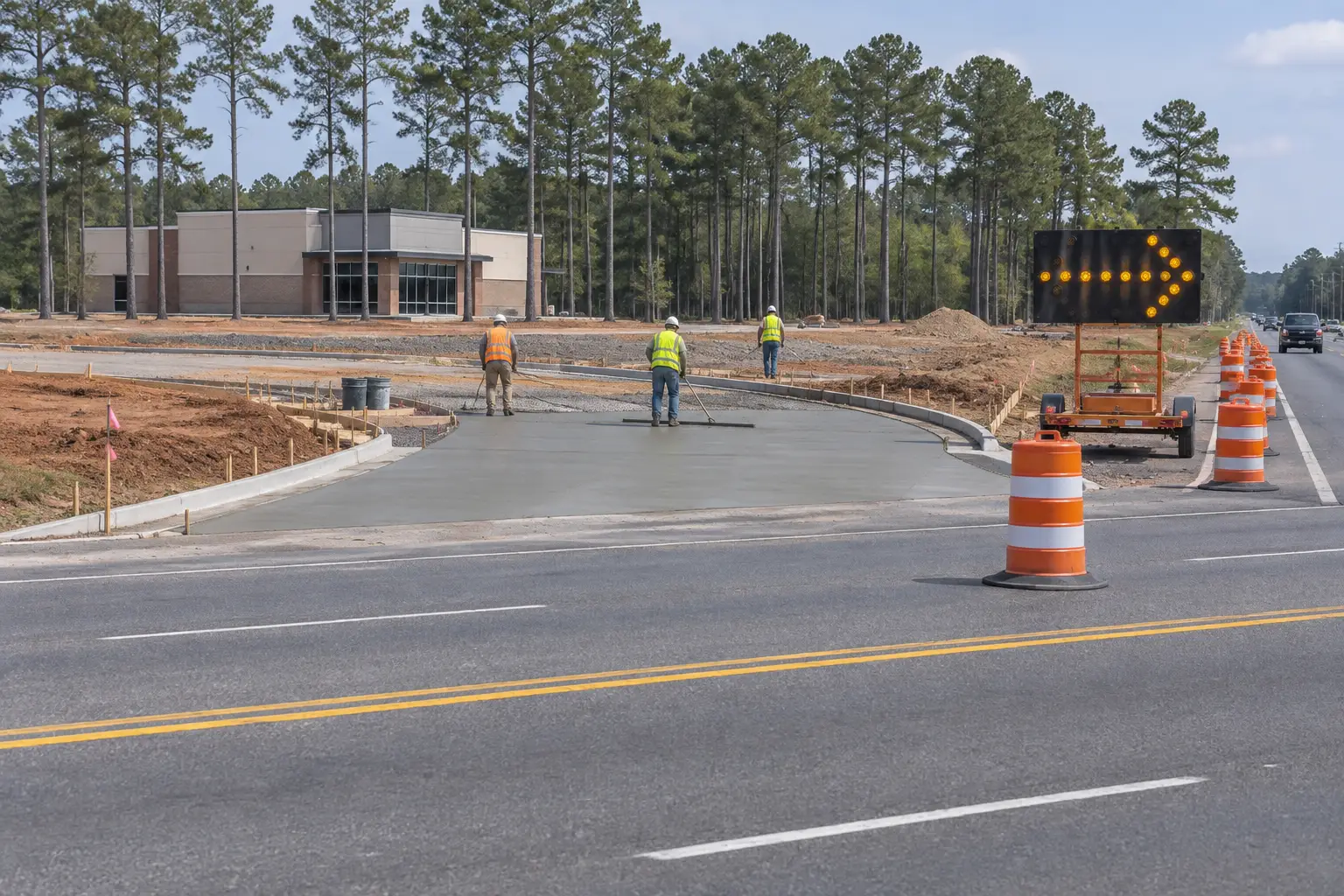
On a state-maintained road in North Carolina, two agencies own the right-of-way question. Filing in the wrong order is one of the most common reasons a schedule slips.
Every week someone calls with the same story. The site plan is approved, the crew is booked, the driveway is drawn, and the city's right-of-way reviewer sends it back with one line: the street is maintained by NCDOT, provide the state's approval first. Two to six weeks disappear before anyone has moved a shovel of dirt.
The fix is not complicated. It is a question you answer on day one: who maintains the road in front of the property?
Two owners, two permits
North Carolina has one of the largest state-maintained road networks in the country. Many streets that look like ordinary city streets, including main roads through Raleigh, Cary and Asheville, are state roads. On those streets NCDOT controls what happens in the right-of-way: driveways, utility cuts, sidewalks, curb cuts and lane closures.
The city still has a say. It reviews the site plan, its own utilities, its stormwater rules and often its own right-of-way permit for work that touches city infrastructure. But it will usually not issue its permit for work on a state road until NCDOT has approved its part.
The order that works
First, confirm maintenance. NCDOT publishes its state-maintained road network as a map and GIS layer. Look up the exact street segment, not just the street name, because maintenance can change at a city limit or an intersection.
Second, if it is a state road, start the NCDOT side: a driveway permit for a new or changed access, or an encroachment agreement for utilities and other work in the right-of-way. Expect the district office to ask for a site plan, the driveway or utility detail, a traffic control plan if lanes are affected, and sometimes a bond.
Third, file the city's right-of-way or utility permit with the NCDOT approval attached, or in parallel if the city allows it and says so in writing. Fourth, schedule inspections with whichever agency owns each piece of work. On a state road the final driveway inspection is often NCDOT's, not the city's.
The city can't approve work on a road it doesn't maintain. Find out who owns the street before you draw the driveway.
Where packages go wrong
The most common mistake is assuming the city will route the package to NCDOT for you. Some jurisdictions coordinate; most expect you to bring both approvals. The second mistake is drawing a driveway to city standards on a state road. NCDOT has its own driveway design manual, and the dimensions, radii and sight-distance rules can differ.
The third is the traffic control plan. A plan that satisfies the city may not match what the NCDOT district expects for the road's speed and volume. Ask early which standard applies.
What to put in your schedule
Treat the NCDOT approval as its own line item with its own lead time, and do not let the crew mobilize until both approvals are in hand. When we prepare a package, we confirm maintenance on the first day, list every agency in order, and build the schedule around the slowest approval rather than the fastest.
None of this changes what the agencies decide. It changes how fast they can decide, because the package arrives complete and in the right order.
Sample post